
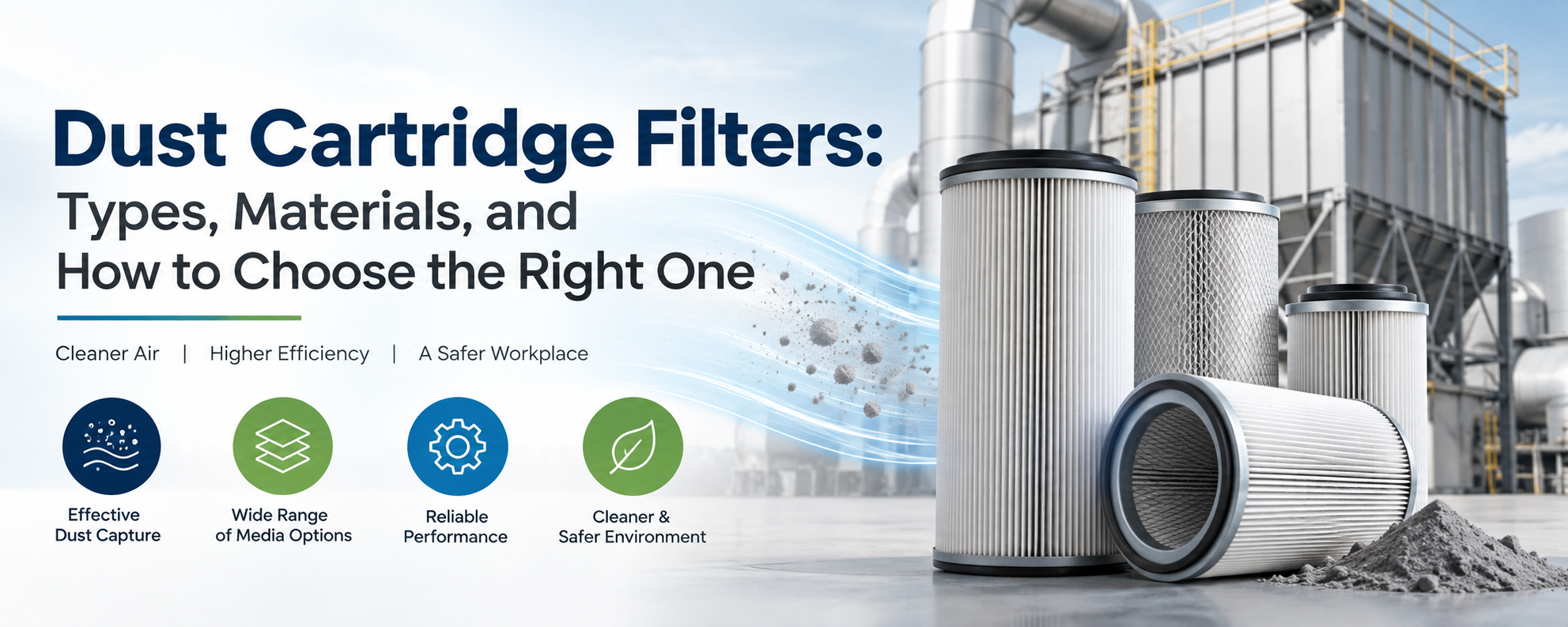
A dust cartridge filter is the working heart of any cartridge-style dust collector. It determines how much dust your system captures, how often your maintenance crew climbs into the collector, how much energy your fan consumes, and whether your facility stays inside its air permit. Choosing the wrong cartridge is rarely dramatic. It shows up quietly as rising pressure drop, shortened filter life, and a plant that never quite hits the emission numbers it was designed to hit.
This guide covers how cartridge filters work, the media types available, how construction affects performance, and the specification decisions that actually matter.
How a Dust Cartridge Filter Works
A dust cartridge is a cylindrical element of pleated media, sealed with end caps and mounted into the cell plate of a dust collector. Dust-laden air enters the collector and passes through the media from the outside inward. Particulate collects on the outer surface while clean air exits through the open core and out the clean air plenum.
Because the media is pleated rather than flat, a single cartridge packs a large amount of filtration surface into a compact footprint. A typical 12.75-inch by 26-inch cartridge can deliver well over 200 square feet of media, which is why cartridge collectors occupy a fraction of the floor space a comparable baghouse requires.
The cleaning cycle is what keeps the system running. Compressed air pulses fire into the open core at set intervals, momentarily reversing airflow and shocking the dust cake off the pleats. The dislodged dust falls into the hopper. This pulse-jet cycle is why cartridge construction matters as much as media selection.
Cartridge Media Types
Media selection depends on your dust characteristics, temperature, moisture, and required efficiency.
Cellulose and Cellulose Blends
The traditional workhorse. Cellulose and polyester-cellulose blends offer good efficiency at low cost and handle general industrial dust well. They are depth-loading, meaning particulate penetrates the media rather than staying on the surface. That gives them solid dust-holding capacity but makes complete pulse cleaning harder over time. Cellulose is also vulnerable to moisture, which limits it in humid environments or applications with condensation risk.
Polyester Spunbond
Fully synthetic media that resists moisture, tolerates humidity, and can be washed in some applications. Spunbond polyester is surface-loading, which means dust releases more cleanly during pulsing and pressure drop recovers better after each cycle. It is the default choice where moisture is present or where cellulose has historically failed early.
Nanofiber-Coated Media
A layer of nanofibers applied to a substrate creates an extremely fine surface structure that captures sub-micron particulate on the face of the media rather than letting it embed inside. The practical result is higher efficiency on fine dust combined with better pulse release and longer service life. Duraweb nanofiber cartridges are built on this principle, and they are typically the right answer for fine, dry dust such as welding fume, powder coating, and pharmaceutical and food powders.
PTFE Membrane Media
The highest efficiency tier. A PTFE membrane laminated to the media surface creates near-total surface loading, capturing sub-micron particulate with minimal penetration and releasing the dust cake almost completely on each pulse. PTFE options such as Dura-Tex 360 and Dura-Tex-C handle sticky, hygroscopic, oily, or extremely fine dust that blinds standard media. They cost more per cartridge but pay for it in service life and stable pressure drop.
Aluminized and Specialty Media
Aluminized polyester dissipates static in combustible dust environments where charge buildup is a deflagration risk. Other specialty constructions address high temperature service, chemical exposure, and unusual dust chemistry. If your dust has an explosivity classification, media selection becomes a safety decision, not just a performance one.
Why Construction Matters as Much as Media
Two cartridges with identical media can perform very differently depending on how they are built.
Most conventional cartridges use an expanded metal outer cage to support the pleats. That cage covers roughly a third of the media face, blocking airflow and creating abrasion points where the metal contacts the media during pulsing. Over time, that contact wears the media thin and creates leak paths.
The Duraweb Dust Cartridges line takes a different approach, using a Helix Bead Wrap that locks each pleat individually in place. The result is about 90 percent open surface area compared with roughly 68 percent for a caged design, along with no cage-to-media abrasion. More open area means more effective pulse cleaning, lower operating pressure drop, and lower fan energy consumption.
When you compare cartridges, ask about open area percentage, pleat spacing, end cap sealing method, and gasket material. These details drive real-world performance more than a headline efficiency number.
About Stainless Steel Filter Cartridges
Stainless steel filter cartridges belong to a different category, and it is worth being clear about where they fit. Built from woven or sintered stainless mesh, they are used primarily in liquid process filtration and in high-temperature, high-pressure, or chemically aggressive service where polymer and cellulose media cannot survive. Their advantages are temperature tolerance, chemical resistance, mechanical strength, and cleanability across many cycles.
For standard ambient-temperature industrial dust collection, stainless cartridges are not the better choice. Their available micron ratings are coarser than nanofiber or PTFE media, and they cost substantially more. Stainless earns its place in dust applications only where temperature, spark risk, or aggressive chemistry rules out conventional media. Specify by application, not by material prestige.
How to Choose the Right Cartridge
- Characterize your dust first. Particle size distribution, moisture content, abrasiveness, stickiness, and explosivity drive every other decision. A dust analysis costs far less than a year of premature cartridge replacements.
- Confirm dimensions and fitment. Cartridge length, outer and inner diameter, end cap style, and gasket configuration must match your collector’s cell plate exactly. Aftermarket cartridges are available for most OEM collectors including Donaldson Torit, Farr APC, AAF, Robovent, Micro-Air, and many others.
- Calculate your air-to-cloth ratio. Divide airflow in CFM by total media area in square feet. Fine dust generally needs a lower ratio. Running too high is the most common cause of short filter life and chronic pressure drop problems.
- Match media to conditions, not to price. The cheapest cartridge that blinds in six weeks costs more than the premium cartridge that runs a year.
- Verify the efficiency claim. Ask for testing under ANSI/ASHRAE 199 or comparable protocols rather than accepting a spec sheet number without a test basis.
Frequently Asked Questions
What is a dust cartridge filter, and how does it work?
A dust cartridge filter is a pleated cylindrical filter element installed in a dust collector. Dust-laden air passes from the outside of the cartridge inward, leaving particulate on the outer media surface while clean air exits through the open core. Compressed air pulses periodically reverse the flow to knock the accumulated dust cake into the hopper, allowing the cartridge to keep working across thousands of cleaning cycles.
Why are stainless steel filter cartridges better than standard cartridges?
They are not universally better; they are better for specific conditions. Stainless steel cartridges outperform standard media where temperatures exceed what polymer or cellulose can handle, where chemistry is corrosive, where high differential pressure is present, or where the element needs to be cleaned and reused repeatedly. For typical ambient dust collection, nanofiber or PTFE media deliver far higher sub-micron efficiency at a fraction of the cost. Choose stainless when the environment demands it, not as a default upgrade.
How often should a dust cartridge filter be replaced?
Replace on differential pressure, not on a calendar. Most cartridges should be changed when pressure drop reaches the manufacturer’s stated limit, commonly in the range of 4 to 6 inches of water column, or when pulse cleaning no longer restores pressure drop to its baseline. Actual service life varies widely with dust loading and media type, ranging from several months in heavy applications to two years or more in light-duty service with premium media. A differential pressure gauge is the single most useful maintenance tool on a cartridge collector.
How do you choose the right cartridge size for an industrial dust collector?
Start with the collector’s OEM specification for cartridge length, outer diameter, inner diameter, and end cap configuration, then confirm gasket type and mounting hardware. Next, verify that the total media area across all cartridges produces an appropriate air-to-cloth ratio for your dust at your design airflow. If the ratio runs high, higher-media-area cartridges can often correct the problem without modifying the collector. When dimensions are uncertain, measuring an existing cartridge or having an industrial filtration specialist review the collector is faster and more reliable than working from an outdated manual.
Getting the Specification Right
Cartridge selection rewards attention. Match media to your dust, verify construction quality, confirm fitment, and monitor pressure drop rather than guessing at intervals. Facilities that do these four things consistently spend less on filters, less on energy, and far less on unscheduled downtime.
If you want the specification confirmed before you order, or you would rather hand off change-outs entirely, DHA Filter offers cartridge evaluation and professional filter installation services across the United States. Call 800-454-2662 to discuss your collector and your dust.