
Industrial dust collector filters are the component most facilities think about least and pay for most. The filter is where compliance is won or lost, where fan energy is consumed, and where maintenance hours disappear. A collector running the wrong filters costs money every single shift, and the cost is invisible until someone compares the numbers.
This guide covers the filter formats available, how to choose between them, what fabrics do what, and how to keep a baghouse running as designed.
The Two Main Filter Formats
Nearly all industrial dust collection comes down to a choice between fabric filter bags and pleated cartridge elements.
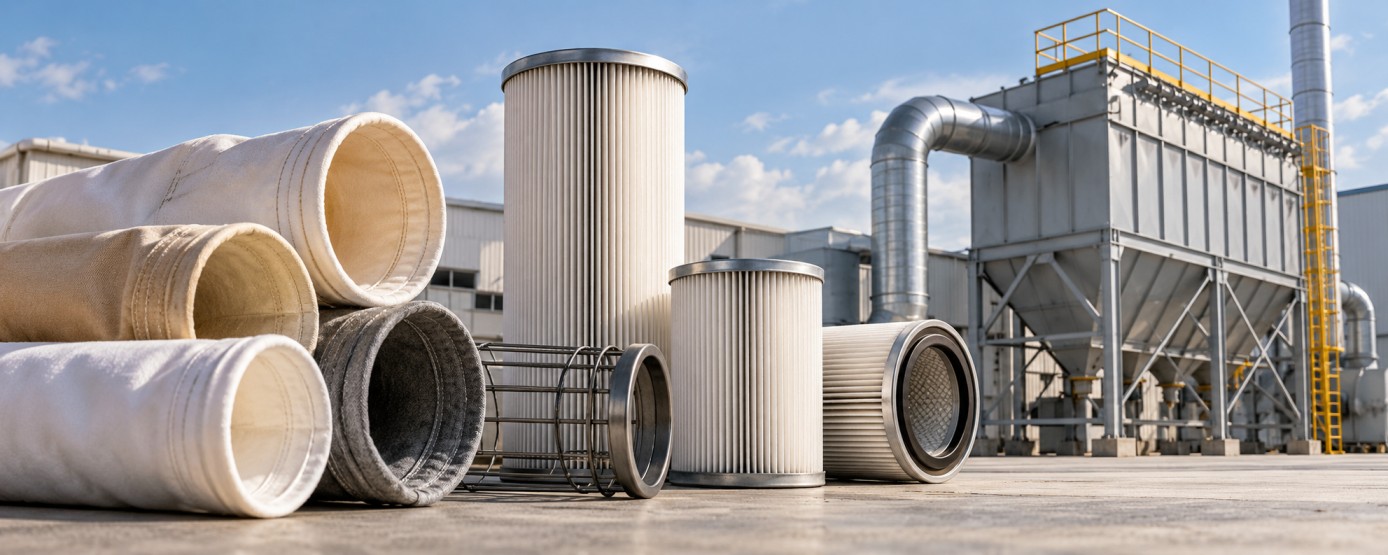
Filter bags are tubular fabric sleeves supported by wire cages in pulse-jet collectors, or suspended from a cell plate in reverse air and shaker designs. Dust builds on the fabric surface and is periodically knocked loose. The format has served heavy industry for decades because it tolerates conditions that defeat other technologies.
Cartridge filters are rigid, pleated elements that pack two to three times the media area into the same opening. They excel with dry, fine, free-flowing dust in space-constrained installations.
Neither format is universally superior. The right answer depends entirely on your dust and your process.
Filter Bag Fabrics and What They Do
Fabric selection is where most specification errors happen. Each material has a defined operating envelope, and exceeding it destroys bags quickly.
- Polyester handles continuous service to roughly 275°F with excellent abrasion resistance and good chemical tolerance. It is the most widely used pulse-jet felt and suits woodworking, agriculture, general manufacturing, and most chemical applications.
- Polypropylene runs cooler, to about 200°F, but offers superior resistance to acids and alkalis. It is the choice for chemically aggressive, lower-temperature gas streams.
- Aramid can handle continuous service to about 400°F, making it standard in foundry, asphalt, and metals applications. It is sensitive to hydrolysis in moist, hot conditions.
- PPS withstands roughly 375°F with strong acid resistance, which makes it the default in coal-fired boiler and incineration service.
- P84 offers high temperature capability with a lobed fiber cross-section that improves fine particulate capture.
- Woven fiberglass reaches about 500°F and dominates cement, lime, and high-temperature process applications.
- Nomex, acrylic, cotton, and nylon monofilament each serve specific niches in temperature, chemistry, and abrasion.
Surface finishes matter just as much. Singed, glazed, PTFE-treated, and ePTFE membrane finishes each change how the dust cake releases. For fine or sticky dust, a membrane finish often doubles usable filter life.
Pleated Filter Bags: A Middle Path
Pleated filter bag elements bridge the two formats. They drop into an existing cell plate opening but deliver two to three times the media area of a conventional bag, which lowers air-to-cloth ratio without touching the collector housing. They also eliminate the separate cage, significantly cutting change-out time.
The tradeoff is the same one cartridges face: standard pleated media tops out around 275°F, and sticky or fibrous dust can bridge between pleats. When those conditions don’t apply, conversion is often the single highest-return upgrade available to an underperforming baghouse.
Pleated bag technology also serves liquid process filtration. The Fluid-Flow Pleated Bags product family, for example, is engineered for high-flow liquid applications with ultrasonically welded seams and inside-to-out flow that retains contaminants during change-out. If your facility runs both air and liquid filtration, sourcing both from one supplier simplifies inventory and specification.
How to Choose: A Practical Decision Path
- Take a dust analysis. Particle size, moisture, abrasiveness, stickiness, and combustibility drive every downstream choice. This step is skipped constantly and causes most filter failures.
- Establish your temperature profile. Not just the average, but the excursion peaks. A one-hour temperature spike can destroy an entire set of bags.
- Calculate air-to-cloth ratio. Airflow in CFM divided by media area in square feet. Fine dust needs a lower ratio. Running high is the most common root cause of chronic pressure drop and short bag life.
- Check chemistry. Acid dew point, alkalinity, oxidizers, and solvents can quickly narrow fabric options.
- Confirm construction details. Seam type, top and bottom configuration, wear strips, and cage compatibility matter as much as fabric. Welded seams eliminate the needle-hole bleed path that sewn seams create.
- Verify combustible dust requirements. NFPA 652 and NFPA 654 obligations may require anti-static media, explosion venting, and specific system design.
Frequently Asked Questions
What are the different types of dust collector filter bags?
Filter bags are categorized by cleaning system and by fabric. By cleaning method, the main types are pulse-jet bags (cleaned by compressed air bursts, with dust collected on the outside surface), reverse air bags (cleaned by gently reversing airflow, with dust collected inside), and shaker bags (cleaned by mechanically shaking the suspension bar, also collecting dust internally). Common fabric categories include polyester, polypropylene, aramid, PPS, P84, acrylic, cotton, nylon, and woven fiberglass, each available in various weights, weaves, and surface treatments. Pleated bag elements form a further category that combines bag fitment with a cartridge-style media area.
Filter bags versus cartridge filters: which is better for your dust collection system?
Cartridge filters generally win where dust is dry, fine, and free-flowing; operating temperature stays below about 275°F; and floor space is limited. Welding fume, powder coating, plasma cutting, and pharmaceutical powder applications typically favor cartridges. Filter bags generally win where temperatures run high, where dust is moist, sticky, fibrous, or abrasive, and where dust loading is heavy. Cement, foundry, asphalt, grain, and boiler applications typically favor bags. The determining factors are temperature, dust characteristics, and grain loading. Cost per element favors bags, while cost per operating hour often favors cartridges in the applications that suit them.
How should baghouse filters be maintained?
Monitor differential pressure continuously; it is the single best indicator of system health. Rising baseline pressure that pulse cleaning cannot restore signals blinding, while a sudden drop usually signals a torn bag or a failed seal. Verify that compressed air is clean and dry, since oil or moisture carried into the pulse system coats media and destroys cake release. Inspect cages for corrosion, bent wires, and wear at contact points, and replace cages when bags are replaced rather than reusing damaged ones. Check hopper discharge regularly, because a hopper that backs up re-entrains dust and drives pressure drop up. Walk the clean-air plenum periodically looking for dust deposits that reveal leaks. Finally, keep records; trending pressure drop and change-out dates turns maintenance from reactive to predictive. For facilities without in-house capacity, scheduled baghouse filter service keeps intervals consistent and catches developing problems before they become emissions events.
How do filter bags help with contamination control?
Filter bags remove particulate from process air before it reaches the workplace atmosphere or the outdoor environment, which serves several purposes at once. They keep respirable dust out of employees’ breathing zone, supporting OSHA permissible exposure limits and general workplace safety. They keep particulate emissions within the limits of your air permit, protecting the facility from enforcement action.
In combustible dust environments, they reduce fuel accumulation that drives deflagration risk under NFPA standards. In product recovery applications, they capture valuable material for return to the process rather than sending it up the stack. And in cleanroom-adjacent or food and pharmaceutical settings, they prevent cross-contamination between production areas. A properly specified and maintained bag does all five jobs simultaneously.
Making the Right Purchase
The best filter is the one specified for your dust, your temperature, and your collector, backed by a supplier who asks about all three before quoting. Start with a dust analysis, be honest about your temperature excursions, calculate your air-to-cloth ratio, and treat differential pressure as the operating metric that governs everything else.
If you want that specification reviewed by someone who works across cartridge, bag, and pleated bag formats every day, get a quote from our team or call 800-454-2662. Bring your collector model, your dust description, and your current pressure drop readings, and the conversation moves quickly.