
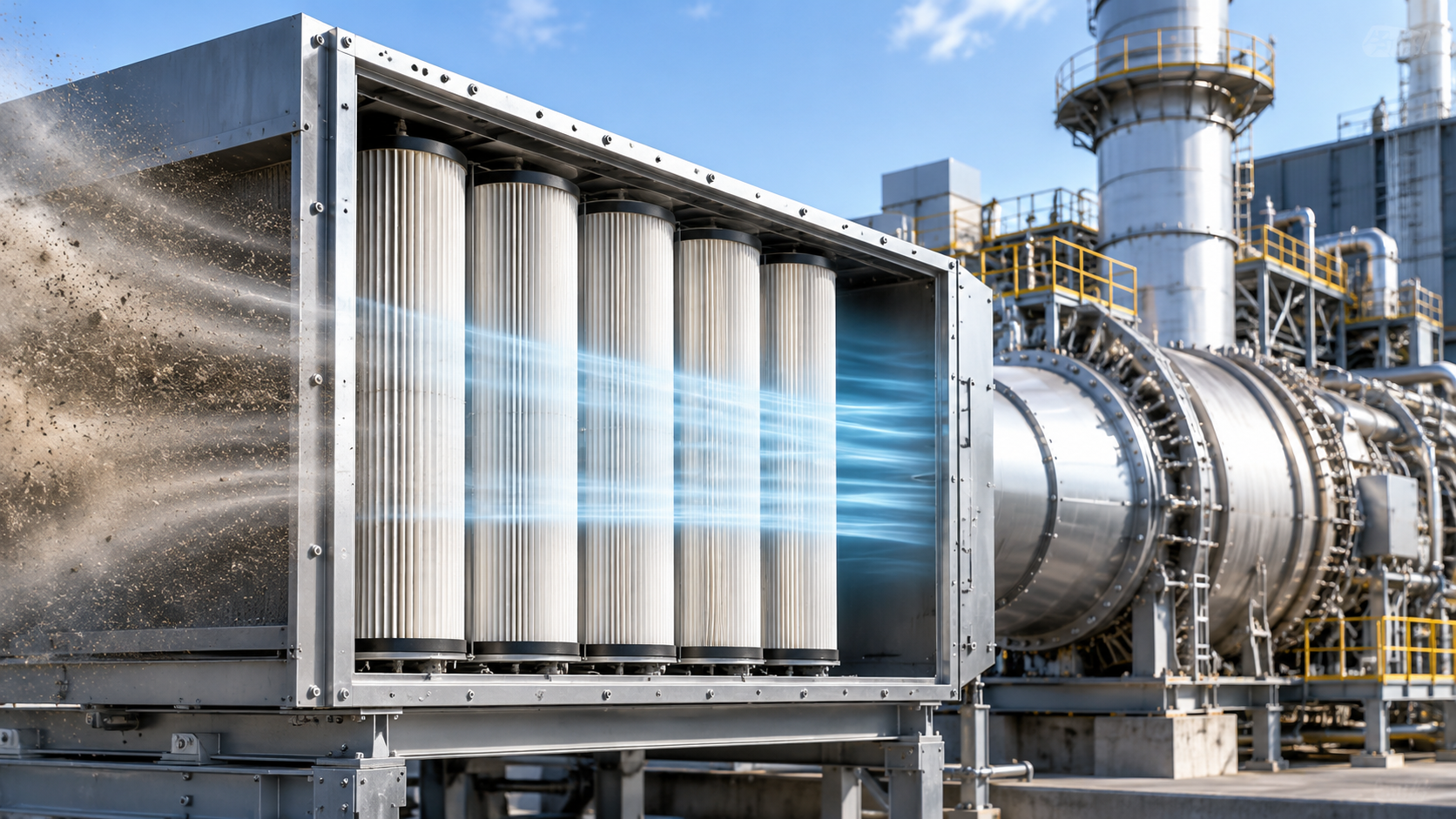
Every particle that gets past a turbine’s inlet filters ends up somewhere it does damage. Most of the fine material lands on compressor blades. Some of it reaches the hot section. And the particles causing the most trouble are the smallest ones, which is exactly where conventional filters are weakest.
That is why gas turbine filtration has moved toward higher efficiency final stages over the past decade or so, and why more operators are replacing F9 cartridges with HEPA-grade elements. The upgrade costs money and adds some pressure drop. Whether it pays back depends on understanding where turbine performance actually goes.
Where Turbine Performance Actually Goes
Compressor fouling is the largest recoverable source of performance loss on most gas turbines. Fine particles, typically under 2 microns, stick to blade surfaces, especially where oil vapor, hydrocarbon aerosols, or moisture act as a binder. The deposits roughen the blades and alter their profile. Airflow falls, pressure ratio falls, and the turbine burns more fuel to make the same power.
Operators fight back with compressor washing. Online washes help between outages, while offline crank washes recover more but take the unit out of service. Neither restores everything, and both treat a symptom.
Two other failure modes accompany fouling. Larger, harder particles erode blade leading edges, and that damage is permanent; no wash reverses it. Salts, sulfates, and other corrosive compounds that pass through the compressor settle on hot section components and drive hot corrosion. On coastal and offshore sites, salt is often a bigger threat than dust. Fine dust can also lodge in the cooling passages of first-stage blades and vanes, which shortens their life in ways that only surface at inspection.
What “HEPA-Grade” Actually Means
The term gets used loosely, so precision helps here. Under EN 1822, the European standard most turbine filter suppliers test against, high-efficiency filters are graded at their most penetrating particle size (MPPS). That is the particle diameter a given filter has the hardest time catching. EPA designates classes E10 through E12, while H13 and H14 are true HEPA.
An E12 filter captures at least 99.5 percent of particles at MPPS. An H13 captures 99.95 percent. In the turbine market, E12 elements are widely sold as “HEPA-grade” because they sit at the threshold of HEPA performance while keeping pressure drop low enough for continuous duty. H13 and H14 turbine filters exist, but the extra resistance is hard to justify on most units.
Now compare that with the F9 cartridges many filter houses still run. F9 is a fine-dust class from the older EN 779 standard, since replaced by ISO 16890, and F9 media lets a meaningful share of sub-micron particles through. Moving from F9 to E12 cuts fine-particle penetration by roughly an order of magnitude. Multiply that by the air volume a gas turbine ingests every hour, and the gap between what reaches the compressor and what doesn’t becomes very large.
The Tradeoff Nobody Can Skip: Pressure Drop
Higher-efficiency filters resist airflow more, and inlet pressure loss reduces output. A figure commonly cited across the industry is roughly half a percent of power for every inch of water column added at the inlet. The exact penalty depends on the machine and ambient conditions.
This is why media construction matters as much as the efficiency class printed on the label. A filter that keeps its pressure drop flat over its service life can cost less output over a year than a cheaper filter that starts low and climbs steeply as it loads. Ask any supplier for the full pressure drop curve, because the initial value alone tells you very little.
How Membrane Construction Changes the Math
Conventional depth media traps dust inside the fiber matrix. That makes it hard to pulse clean, and pressure drop creeps upward month after month. Membrane media works differently: an expanded PTFE (ePTFE) membrane catches particles on its surface, so a cleaning pulse knocks the dust cake loose and pressure drop recovers.
DHA’s HEPA Grade Gas Turbine Filtration line, Duraweb Elite, uses this approach. Each element combines a hydrophobic, oleophobic prefilter barrier; a hydrophobic ePTFE membrane rated E12 at MPPS; and a structural polyester backing. DHA positions it as an upgrade for filter houses currently running F9 cartridges. Instead of an expanded-metal outer cage, its Tri-Bead pleat-locking system uses a helix bead wrap, which DHA says leaves about 90 percent of the media surface open compared with roughly 68 percent for a caged design.
The membrane’s water resistance turns out to matter almost as much as its particle efficiency. The weather section below explains why.
The System Around the Filters
A HEPA-grade element performs only as well as the filter housing it sits in. Leaking door seals, damaged gaskets, and gaps at the tube sheet let unfiltered air bypass the media entirely. Even a small bypass leak can let more fine dust through than the filters themselves do.
Pulse-cleaned houses add another dependency. Their cleaning systems run on diaphragm valves, solenoids, and differential pressure gauges, the same hardware found on industrial dust collectors, and when those parts fail, they tend to fail quietly. DHA’s preventative maintenance & repair services cover diaphragm and solenoid valve repair, system inspections, and differential pressure instrumentation, and the company carries replacement parts & equipment for industrial filtration systems more broadly. Whoever does the work should inspect seals and cleaning hardware every time filters come out.
Frequently Asked Questions
How does a gas turbine filtration system improve turbine efficiency?
By keeping the compressor clean. A turbine’s output and heat rate depend on the compressor moving its designed mass of air at its designed pressure ratio, and fouled blades can do neither. Effective filtration slows the rate at which deposits build, so the unit stays closer to its new-and-clean performance between washes. It also reduces how often offline washes are needed, which means fewer outages, and it limits the erosion and hot corrosion that shorten the life of blades, vanes, and combustion hardware. The gain shows up less as a single number and more as a flatter degradation curve over months of operation.
What is the role of HEPA-grade gas turbine filters?
HEPA-grade gas turbine filters capture the sub-micron particles responsible for most compressor fouling, the size range where F9 and other conventional fine-dust filters struggle. An E12 element stops at least 99.5 percent of particles at its most penetrating size. Membrane versions double as a moisture barrier, blocking water droplets and dissolved salt that would pass straight through ordinary media in wet weather. Operators who switch generally report slower performance decline and longer intervals between washes, which is where the upgrade pays for itself.
What are the signs that gas turbine filters need to be replaced?
Differential pressure across the filter stage is the most reliable signal. Replace filters when pressure drop approaches the limit set by the turbine OEM or filter house manufacturer, or when pulse cleaning no longer brings it back down. Watch for these as well:
- A sudden drop in differential pressure, which almost always means torn media or a failed seal rather than good news
- Falling output or rising heat rate at comparable ambient conditions
- Compressor washes needed more often than usual.
- Dust streaks, wet patches, or corrosion on the clean-air side of the house
- Deposits on the early compressor stages during a borescope inspection
Many plants also change filters at planned outages, before they reach the limit, so a change-out never forces an unplanned shutdown.
How do weather conditions affect gas turbine filtration?
More than most people expect. Fog and sustained high humidity are the hardest conditions on conventional media, because dust already captured in the filter absorbs moisture and swells, and pressure drop can spike within hours. Salt behaves even worse. Above roughly 75 percent relative humidity, sodium chloride absorbs water and turns into brine, which can wick through ordinary filter media and recrystallize downstream on the compressor. Hydrophobic membrane filters block that liquid path.
Rain and snow are mostly handled upstream by weather hoods, vane separators, and coalescer pads, though blowing snow can still pack into hoods and choke airflow. In cold, humid air near freezing, ice can form on filters and inlet surfaces, which is why many sites run anti-icing systems. Desert sites face the opposite problem: dust storms that load filters in days, where pulse-cleanable designs prove their value. Seasonal events count too. Cottonwood seed, pollen, and insect swarms can blind a prefilter stage within a week.
Where to Start
If you are weighing an upgrade, pull twelve months of operating data before talking to any supplier: differential pressure trends, wash frequency, and output corrected for ambient conditions. Those three records will show whether fouling is costing enough to justify HEPA-grade elements, and they give you a baseline to measure the new filters against once they are installed. To review your filter house and current elements, call DHA Filter at 800-454-2662.